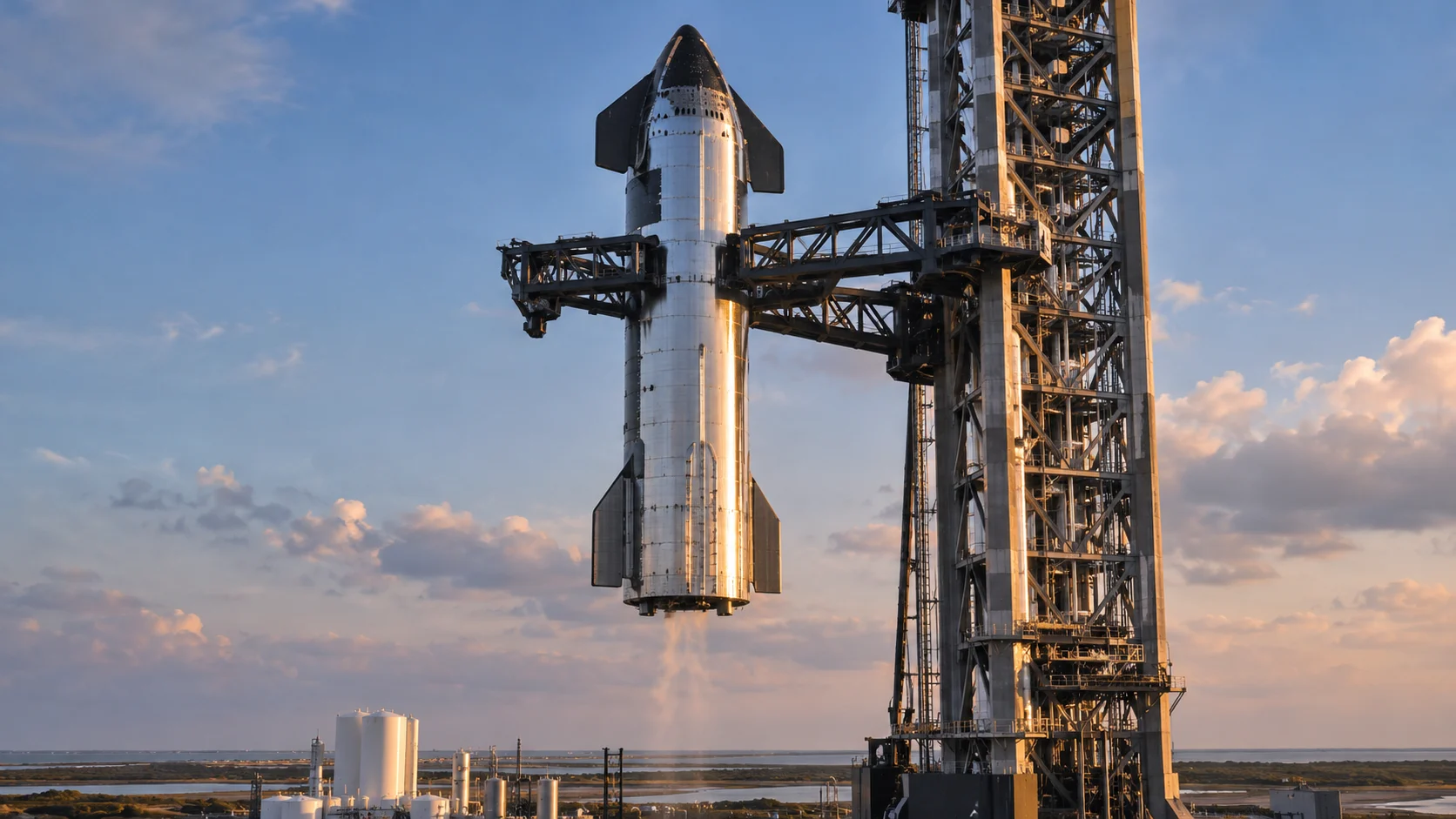
Space exploration has reached another exciting milestone. SpaceX Starship has successfully returned from space and been caught by the giant mechanical arms of its launch tower in Texas. This achievement marks an important step toward making rockets and spacecraft reusable, potentially changing how future space missions are planned and carried out.
The historic event took place during SpaceX’s Flight 15 test mission. While the spacecraft successfully returned to its launch site, the mission also experienced a setback involving its Super Heavy booster. Nevertheless, the successful recovery of the Starship upper stage represents a major technological achievement.
So, what exactly happened, how did the catch work, and why is everyone talking about it? Let’s explore the details.
SpaceX Starship represents a major step forward in the development of fully reusable spacecraft.
Readers can explore the SpaceX Starship official website to learn more about the spacecraft’s design, capabilities, and reusable rocket technology.
What Happened During the Latest SpaceX Starship Mission?
SpaceX successfully caught its Starship upper stage using the mechanical arms of its launch tower at Starbase, Texas. The spacecraft returned after spending approximately 22.5 hours in space.
The catch happened on November 14, 2026, local Texas time, following the launch of Flight 15 on November 13. For viewers in India, the historic recovery took place early on November 15.
This was the first successful recovery of a Starship upper stage using the launch tower’s mechanical arms. SpaceX had previously demonstrated similar catches with its Super Heavy booster, but recovering the spacecraft itself was a new achievement.
The event demonstrated that Starship could potentially return to its launch site instead of being discarded after completing a mission.
Why Is This Achievement So Important?
Traditional rockets often lose significant parts of their launch systems after a mission. Some components may fall into the ocean, while others are destroyed during flight or reentry.
Reusable rocket technology aims to change that approach.
Imagine travelling in an aircraft that could only complete one journey before being thrown away. It would be incredibly expensive and inefficient. Reusable rockets follow a different philosophy: recover major components, inspect them, prepare them and use them again when they are ready.
The successful Starship catch brings SpaceX closer to its goal of developing a fully reusable launch system.
However, one successful catch does not mean the entire rocket is ready for routine commercial use. Additional testing, inspections and improvements will still be necessary.
Understanding the Starship Flight 15 Mission
The latest SpaceX Starship mission demonstrated how advanced rocket recovery technology could transform future space travel.
Flight 15 was designed to test several important capabilities, including orbital operations, satellite deployment and the recovery of both rocket stages.
According to the latest Starship recovery report, the spacecraft successfully returned from orbit and was caught by the launch tower’s mechanical arms.
When Did the Mission Launch?
The mission launched on November 13, 2026, from SpaceX’s Starbase facility in South Texas.
The launch vehicle consisted of two major components:
- Super Heavy Booster: The powerful first stage responsible for lifting the spacecraft away from Earth.
- Starship Ship: The upper-stage spacecraft designed to continue the journey into space.
Together, these components form one of the most ambitious rocket systems currently under development.
What Happened During the Flight?
After launch, Super Heavy separated from the upper-stage spacecraft. Starship continued its journey and reached orbit.
During the mission, the spacecraft deployed 26 Starlink V3 satellites. It also completed approximately 14 orbits around Earth before beginning its return journey.
After completing its orbital activities, Starship performed a deorbit burn and prepared to reenter Earth’s atmosphere.
The spacecraft then returned toward its launch site in Texas, where the launch tower’s mechanical arms successfully caught it.
How Did SpaceX Catch Starship?
The recovery was possible because of a specially designed launch tower equipped with two enormous mechanical arms.
These arms are commonly known as chopsticks because of their appearance and function.
Instead of landing on traditional legs, Starship approached the tower in a controlled manner. The spacecraft positioned itself for recovery, and the mechanical arms caught it as it returned to the launch structure.
What Is the Mechazilla Launch Tower?
Mechazilla is the nickname given to SpaceX’s large launch and recovery tower.
It is designed to support Starship operations, including launch preparation, vehicle handling and recovery.
The tower’s mechanical arms are one of its most unusual features. They are intended to catch returning rocket stages and help prepare them for future operations.
How Do the Mechanical Arms Work?
The recovery system uses large mechanical structures attached to the launch tower.
During a planned catch, the returning vehicle must reach the correct position and speed. Its guidance systems help control its movement as it approaches the tower.
The mechanical arms then catch and support the vehicle.
This is a demanding operation because a small positioning error could create serious problems. The successful recovery of Starship demonstrated that SpaceX has made significant progress in this challenging area of rocket engineering.
What Made the Starship Catch Historic?
The most important part of this achievement was that Starship’s upper stage returned from orbit and was caught at its launch site.
Previously, SpaceX had demonstrated the recovery of Super Heavy boosters, but catching the upper-stage spacecraft introduced another level of complexity.
Starship travels much farther and reaches orbital speeds before returning through Earth’s atmosphere.
Its recovery therefore involves several demanding stages:
- Completing the planned orbital mission.
- Performing the necessary deorbit manoeuvre.
- Surviving atmospheric reentry.
- Controlling its descent toward the launch site.
- Positioning itself for the mechanical-arm catch.
Successfully completing these steps shows how far reusable spacecraft technology has progressed.
Did the Entire Mission Go as Planned?
SpaceX Starship is designed to carry cargo and eventually humans on missions beyond Earth.
Not completely.
Although the Starship upper stage achieved its historic catch, the mission’s original objective was to recover both the upper stage and the Super Heavy booster.
The booster did not complete its planned return to the launch tower.
What Happened to the Super Heavy Booster?
After separating from Starship, the Super Heavy booster experienced a problem during its return journey.
According to SpaceX’s flight updates, a low-fuel-mass alarm led to an early end to its boostback burn. Its guidance system then detected that it was not in the correct position for a tower catch.
The booster automatically aborted the planned catch and diverted toward an offshore landing area in the Gulf of Mexico. It subsequently exploded before reaching the water.
This means the mission achieved an important recovery milestone, but the full two-stage recovery objective was not completed.
The booster issue also provides SpaceX with additional information that can be used to improve future flights.
How Does Reusable Rocket Technology Work?
Engineers continue improving SpaceX Starship to make future launches safer, faster, and more cost-effective.
Reusable rocket technology focuses on recovering and reusing major rocket components instead of manufacturing an entirely new launch vehicle for every mission.
A reusable launch system must be designed to survive the extreme conditions of launch, spaceflight and return.
It also needs reliable navigation, propulsion, thermal protection and recovery systems.
Why Is Rocket Reusability Important?
Reusability could make space missions more affordable and frequent over time.
However, recovering a rocket is only one part of the process. Engineers must inspect its structure, engines, heat protection and other components before approving another flight.
Reducing Launch Costs
Manufacturing large rockets requires significant resources, engineering time and specialised materials.
If major rocket components can be recovered and reused safely, operators may reduce the need to manufacture replacement vehicles for every launch.
These savings are not automatic. Recovery, refurbishment, testing and maintenance also cost money.
Still, successful reuse could improve the economics of launching payloads into space.
Making Space Travel More Efficient
Reusable vehicles could support more frequent missions by reducing the time and resources needed to prepare launch systems.
This could benefit satellite deployment, scientific research, cargo transportation and future human spaceflight.
It may also help make ambitious space projects more practical over the long term.
What Does This Mean for Future Space Missions?
The successful recovery of Starship’s upper stage could influence the future development of large launch vehicles.
SpaceX wants to build a system capable of transporting cargo, satellites and eventually people beyond Earth.
A reliable recovery process would be an important part of achieving that goal.
Future missions will need to demonstrate that Starship can return safely, undergo inspection and fly again without requiring extensive replacement work.
The more consistently the system performs, the closer it could move toward regular operations.
For readers interested in more technology developments, digital innovation and informative online guides, visit our website and Read More articles on ArticleBloom.
How Could Starship Support NASA’s Moon Missions?
NASA has selected a version of SpaceX’s Starship as part of its Artemis lunar exploration plans.
The spacecraft is intended to support astronaut transportation between lunar orbit and the Moon’s surface.
However, this requires several technologies to work together successfully.
Starship will need to demonstrate reliable operations, suitable life-support systems, lunar landing capabilities and the ability to support complex missions.
The recent recovery milestone is relevant because reusable transportation could play an important role in future lunar exploration.
It is not, by itself, proof that Starship is ready to carry astronauts to the Moon. More testing and development remain necessary.
Could Starship Eventually Travel to Mars?
One of SpaceX’s long-term ambitions is to use Starship for missions to Mars.
The company envisions a future in which large spacecraft could transport equipment, supplies and people to the Red Planet.
Such a mission would require much more than a successful launch and landing.
Engineers would need to solve challenges involving long-duration spaceflight, radiation protection, life support, communication delays, fuel management and landing on another planet.
Starship’s development is intended to help build the transportation capabilities needed for these ambitions.
However, human missions to Mars remain a future goal rather than an established operational capability.
What Challenges Does SpaceX Still Need to Solve?
Despite the successful catch, several important engineering challenges remain.
1. Reliable booster recovery: The Super Heavy booster must consistently complete its return manoeuvres and recovery operations.
2. Heat shield performance: Starship needs reliable thermal protection to withstand repeated atmospheric reentries.
3. Vehicle inspection: Recovered vehicles must be inspected carefully to identify damage and determine whether they are safe to fly again.
4. Rapid refurbishment: SpaceX wants to reduce the time between flights while maintaining safety and reliability.
5. Mission reliability: Future flights must demonstrate consistent performance across launches, orbital operations and recovery.
These challenges show why the Starship program continues to require extensive testing.
What’s Next for the SpaceX Starship Program?
The next stage will involve analysing the Flight 15 results, investigating the booster recovery issue and preparing future test flights.
SpaceX will need to demonstrate that both stages can be recovered reliably and that the spacecraft can be reused safely.
The company is also working toward expanding Starship operations and supporting future missions involving satellites, cargo and human exploration.
The successful upper-stage catch is an encouraging step, but the real test will be whether SpaceX can repeat the achievement and turn it into a dependable operational process.
The success of SpaceX Starship could influence the future of commercial space exploration.
Conclusion
The latest SpaceX Starship mission represents a major milestone in the development of reusable rocket technology. During Flight 15, the spacecraft completed its orbital activities, deployed 26 Starlink satellites and returned to Texas, where the Mechazilla launch tower successfully caught it.
Although the Super Heavy booster did not complete its planned recovery, the upper-stage catch demonstrated an important new capability.
This achievement could help shape the future of satellite launches, lunar exploration and deep-space transportation. However, further testing and engineering improvements will be essential before Starship can become a regularly reusable launch system.
One thing is clear: the future of space exploration is moving toward more ambitious and reusable technology.
Frequently Asked Questions (FAQs)
1. What is SpaceX Starship?
SpaceX Starship is a large, fully integrated launch vehicle being developed to transport cargo and people into space. It consists of the Super Heavy booster and the Starship upper-stage spacecraft.
2. When did SpaceX catch Starship for the first time?
SpaceX successfully caught the Starship upper stage on November 14, 2026, at its Starbase facility in Texas, following Flight 15.
3. What is the Mechazilla tower?
Mechazilla is the nickname for SpaceX’s launch and recovery tower. It has large mechanical arms designed to catch returning rocket stages.
4. Did both Starship stages return successfully during Flight 15?
No. The Starship upper stage was successfully caught by the launch tower, but the Super Heavy booster aborted its planned catch and diverted toward the Gulf of Mexico.
5. Why is reusable rocket technology important?
Reusable rocket technology could reduce manufacturing requirements, support more frequent launches and improve the long-term economics of space exploration. It still requires reliable recovery, inspection and refurbishment systems.