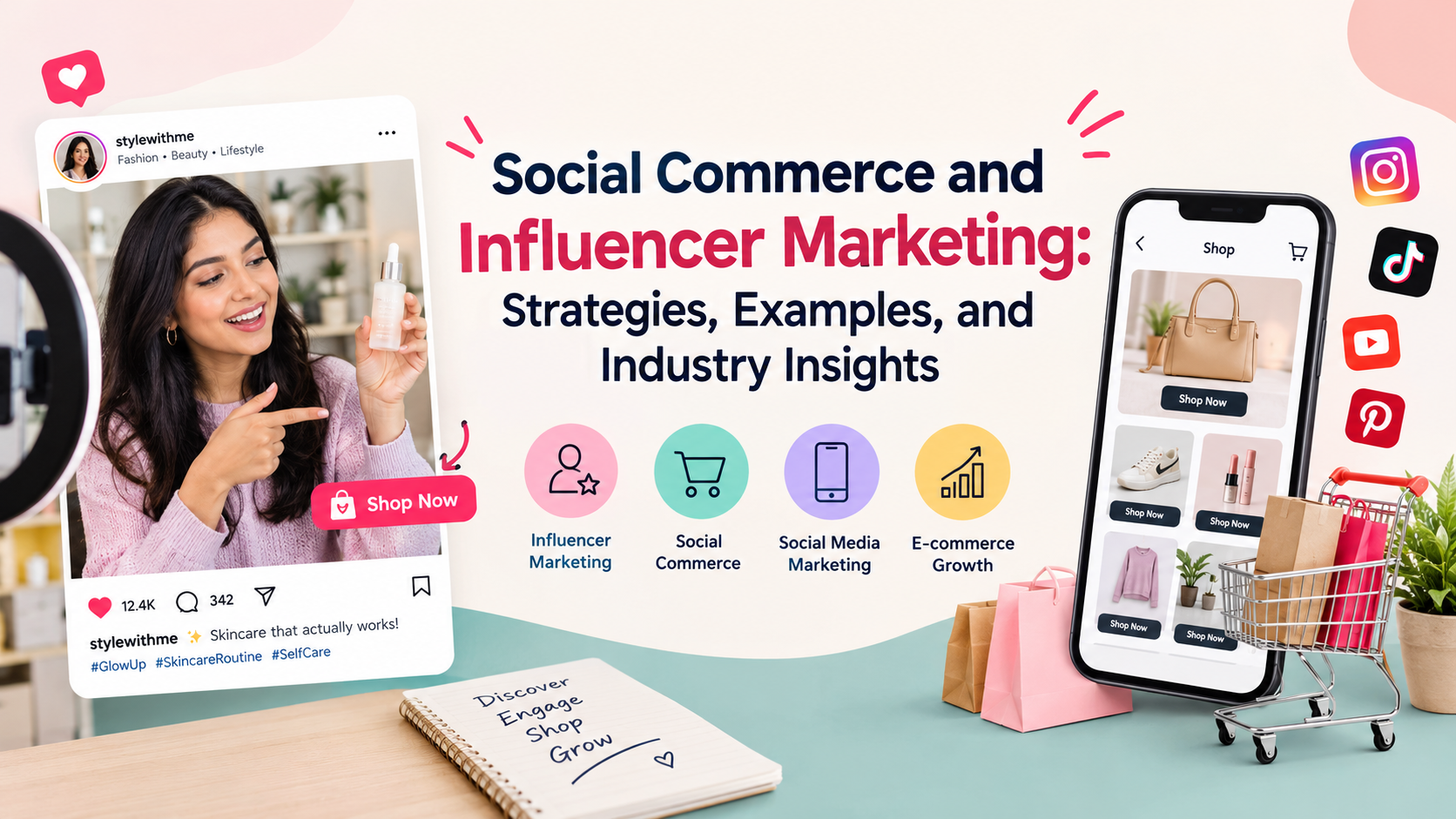
Social Commerce and Influencer Marketing: Strategies, Examples, and Industry Insights
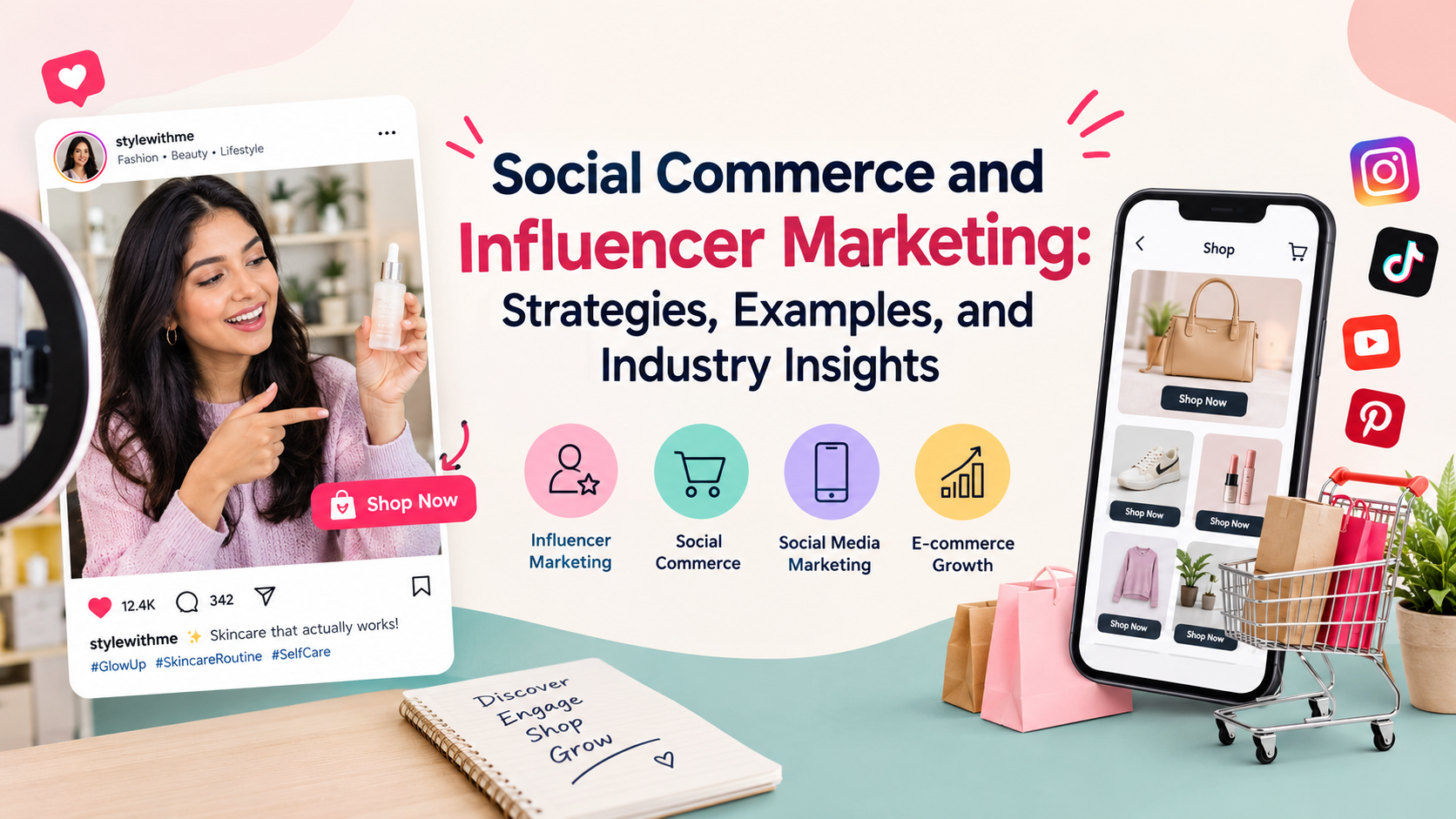
Social media has become more than a place to share photographs, watch videos, and communicate with friends. It is increasingly part of how consumers discover products, evaluate brands, and make purchasing decisions.
A skincare recommendation from a trusted creator, a product demonstration on Instagram, or a detailed review on YouTube can introduce consumers to businesses they might never have discovered through traditional advertising.
This shift has created a strong connection between social commerce and influencer marketing. While influencer marketing helps brands communicate through content creators, social commerce connects product discovery and social interaction with shopping opportunities.
The commercial potential is significant. According to Boston Consulting Group’s 2025 report, From Content to Commerce: Mapping India’s Creator Economy, India’s 2–2.5 million monetized content creators influence an estimated $350–400 billion in consumer spending. BCG projects that creator-influenced consumption could exceed $1 trillion by 2030. These figures describe spending influenced by creators, rather than revenue earned by the influencer marketing industry itself.
For businesses, the opportunity is not simply to collaborate with popular personalities. It is to understand how creator content affects consumer behaviour and how that influence can translate into measurable business results.
What Is Influencer Marketing?
Influencer marketing is a digital marketing strategy in which businesses collaborate with content creators to promote products, services, or brands to relevant audiences.
These creators may publish sponsored videos, product demonstrations, reviews, tutorials, or recommendations. Their value comes from their ability to communicate with an established audience around a particular interest, industry, or lifestyle.
For example, a personalized gifting company might collaborate with a lifestyle creator who regularly shares gift ideas. The creator could demonstrate how customers personalize a journal, explain its features, and show how it might be used as a birthday or anniversary gift.
Unlike conventional advertising, which often communicates directly from a brand to a consumer, influencer marketing uses a creator’s existing content and audience relationships to introduce the product.
However, influence does not automatically translate into sales. Campaign performance depends on factors such as audience relevance, content quality, product value, pricing, and the purchasing experience.
How Influencer Marketing Works
An influencer campaign usually begins with a business objective. The brand then identifies suitable creators, agrees on campaign deliverables, develops a content brief, and establishes a method for measuring results.
A campaign might focus on brand awareness, product launches, website traffic, qualified leads, or direct sales.
For a sales-oriented campaign, a business could provide each creator with a unique tracking link or discount code. This helps the marketing team identify the traffic and purchases associated with each collaboration.
The process should also include clear sponsorship disclosures, agreed content usage rights, and guidelines for product claims.
When these elements are planned properly, influencer marketing becomes more than a promotional activity. It becomes a measurable part of the wider marketing strategy.
Types of Social Media Influencers
Influencers are often classified according to their audience size, although follower-count definitions vary across marketing platforms.
- Nano-influencers: Creators with small, focused communities who may be suitable for niche products and local campaigns.
- Micro-influencers: Creators with established audiences around particular interests, such as fashion, books, fitness, or technology.
- Macro-influencers: Creators with larger audiences who can support broader awareness campaigns.
- Celebrity influencers: Public figures whose recognition may help brands reach a wide audience.
Don’t choose an influencer just because they have a large number of followers. Focus on how relevant their audience is to your brand and how well they engage with their followers.. A creator with a smaller but highly relevant audience may be a better fit for a specialized product than a celebrity whose followers have limited interest in the category.
What Is Social Commerce?
Social commerce refers to the use of social media platforms and their shopping-related features to discover, promote, and purchase products.
Depending on the platform and market, consumers may browse product catalogs, watch demonstrations, interact with sellers, explore creator recommendations, and complete purchases through supported shopping features or linked websites.
For instance, a consumer might discover a handbag in an Instagram Reel, visit the brand’s profile, read customer comments, and follow a product link to complete the purchase.
The important distinction is that social commerce connects social interaction with commercial activity.
Traditional e-commerce generally begins with an online store or marketplace, while social commerce often begins with content, a recommendation, or a conversation. The two approaches can work together rather than compete with one another.
Social Commerce vs. Traditional E-commerce
Traditional e-commerce gives shoppers a structured environment for browsing products, comparing specifications, reviewing prices, and completing transactions.
Social commerce introduces a more discovery-led experience. Instead of actively searching for a product, consumers may encounter it while watching a tutorial, following a creator, or exploring a community.
Consider a customer looking for a personalized notebook. Through traditional e-commerce, the customer might search for notebooks, compare prices, and choose a seller.
Through social commerce, the customer might first see a creator demonstrate a notebook with a customized name and message. The demonstration creates interest, while the comments and product information help the customer evaluate the purchase.
Both journeys can lead to a sale. The difference lies in how the customer discovers and evaluates the product.
Leading Social Commerce Platforms
The most appropriate social commerce platform depends on the product category, target audience, and available shopping features.
Instagram and Facebook can support visual product discovery, creator collaborations, community interaction, and product promotion.
YouTube is particularly useful for detailed demonstrations, comparisons, tutorials, and product reviews that help consumers make informed decisions.
TikTok offers creator-led discovery and shopping functionality in supported markets.
Pinterest helps people discover ideas and inspiration for fashion, home décor, celebrations, and gifts through engaging visual content.
Businesses should verify current shopping and checkout availability in their target country. A platform may be useful for discovery even when transactions must be completed through an external e-commerce website.
How Social Commerce and Influencer Marketing Work Together
Influencer marketing and social commerce serve different but complementary purposes.
Influencer marketing introduces a product through content created for a relevant audience. Social commerce helps interested consumers explore the product and move towards a purchase.
The relationship can be understood through five stages:
- Discovery: A consumer encounters a product through a creator’s content.
- Interest: The demonstration or recommendation encourages further exploration.
- Consideration: The consumer reviews product information, comments, prices, and alternatives.
- Conversion: The consumer purchases the product through an available shopping channel.
- Retention: A positive experience may lead to repeat purchases, recommendations, or customer reviews.
Not every consumer follows this journey in a straight line. Some people may save a video and return several days later. Others may search for the brand separately before purchasing.
That is why businesses should consider the entire customer journey instead of judging a campaign exclusively by likes or immediate sales.
The Growth of Influencer Marketing in India
India’s creator economy is becoming an increasingly important part of digital marketing and commerce. Brands are using creator content not only to increase visibility but also to support product consideration, customer acquisition, and sales.
Industry research provides useful evidence of this shift.
What Industry Research Reveals
A June 2025 report from WPP Media’s The Goat Agency, developed in collaboration with Kantar, estimated India’s influencer marketing industry at ₹3,600 crore in 2024 and forecast 25% growth in 2025. The report also highlighted the importance of content quality, creator relevance, and longer-term partnerships.
A separate Kofluence report covered by The Economic Times in May 2026 estimated the industry’s value at ₹3,000–3,500 crore in 2025, with a projection of ₹4,500–5,000 crore by 2027.
These are separate industry estimates produced at different times using different research approaches. They should not be treated as directly interchangeable measurements. Nevertheless, both reports point towards a substantial and increasingly organized creator economy.
Sources: WPP Media and Kantar’s India Influencer Marketing Report 2025 and The Economic Times’ coverage of Kofluence’s 2026 report.
The business implication is clear: brands need to evaluate influencer marketing through both creative quality and commercial performance. A campaign should have a defined purpose, a suitable audience, and a reliable way to assess results.
The Role of India’s Regional Creator Economy
India’s digital audience is diverse, with consumers engaging in different languages, cultural contexts, and product categories.
Regional creators can help brands communicate in ways that feel familiar to specific communities. Their content may be particularly useful for local businesses, regional product launches, and brands targeting consumers outside major metropolitan areas.
For example, a homegrown skincare brand might collaborate with creators who produce content in Hindi, Tamil, Bengali, or another relevant language. The choice should depend on the audience the business wants to reach, rather than on the assumption that one language works for every market.
Regional relevance can improve the usefulness of a campaign, but brands should still evaluate audience authenticity, content quality, and the commercial fit of each partnership.
Why Influencer Marketing Matters for E-commerce Businesses
Influencer marketing can help e-commerce businesses address several common challenges: limited brand awareness, uncertainty about product quality, and difficulty reaching potential customers.
Building Consumer Trust
Online shoppers cannot always examine a product before purchasing it. They may need additional information about its material, appearance, functionality, or suitability.
A well-produced demonstration can help answer these questions more effectively than a generic promotional message.
For example, a creator reviewing a personalized journal could show its cover, demonstrate the personalization options, and explain its practical uses.
Trust, however, depends on transparency and credible communication. Undisclosed sponsorships or exaggerated claims can damage both the creator’s reputation and the brand’s credibility.
Increasing Product Discovery
Influencer campaigns can introduce products to audiences who might not have encountered them through search engines or traditional advertising.
This is especially relevant for products that benefit from visual demonstrations, such as clothing, accessories, home décor, beauty products, and personalized gifts.
Meta reported in June 2025 that, in a study of Indian shoppers commissioned from GWI, almost eight in ten respondents discovered products through social media. Meta also reported that 96% of these social-media product discoverers used Meta platforms. These findings are useful evidence of social discovery, but they should be interpreted in the context of that particular study rather than as universal statistics for every Indian consumer.
Source: Meta’s report on creators, short-form videos, and retail in India.
Supporting Purchase Decisions
Consumers often need more than awareness before they buy. They may want to compare alternatives, understand how a product works, or see whether it suits their needs.
Creators can provide that information through reviews, tutorials, demonstrations, and comparisons.
For businesses, the objective is to make the buying decision easier by answering genuine customer questions. A useful campaign should communicate what a product does, who it is designed for, and what customers should realistically expect.
Influencer Marketing Examples in India
The following examples illustrate practical campaign models. They are hypothetical scenarios, not claims about the sales performance of specific companies.
Beauty and Personal Care
A skincare business could collaborate with creators who explain product ingredients, demonstrate application, and discuss the intended use of a product.
The campaign might include a tutorial, a product demonstration, and a follow-up review. Each piece of content should communicate accurate information and avoid unsupported medical claims.
The brand could then compare the campaign’s reach, product-page visits, and tracked sales to determine which format performed best.
Fashion and Lifestyle
A clothing brand could work with fashion creators to demonstrate different ways of styling an outfit, explain fabric details, and show how a product looks in everyday settings.
This approach gives shoppers a better understanding of the product than a single catalogue photograph.
The business could use creator-specific links to measure website traffic and evaluate which styles attracted the most interest.
Food and Small Businesses
A bakery could collaborate with local food creators to demonstrate its products, explain its ordering process, and showcase packaging.
Similarly, a small gifting business could partner with book or lifestyle creators to demonstrate personalized journals and suggest occasions for giving them as presents.
The strongest collaborations are built around a genuine connection between the product and the creator’s audience. A large following cannot compensate for a poor fit.
How to Build an Effective Influencer Campaign
A successful influencer campaign begins with a measurable objective and a clear understanding of the intended audience.
Set Measurable Campaign Objectives
Before contacting creators, decide what the campaign needs to achieve.
An awareness campaign might focus on reach and video views. A traffic campaign could prioritize qualified link clicks and landing-page engagement. A sales campaign should track purchases, revenue, acquisition costs, and profitability.
These objectives require different reporting methods. Measuring a sales campaign only by likes or views will not provide enough information to determine whether the investment was commercially worthwhile.
Find the Right Influencers
Review a creator’s content, audience interests, engagement quality, and previous brand collaborations.
Where possible, request audience analytics that show relevant locations and demographic characteristics. This is particularly important when targeting a specific country.
For example, a business selling to US customers should check whether a creator actually reaches the intended American audience. English-language content alone does not establish audience location.
Businesses should also review brand suitability, disclosure practices, and the creator’s ability to produce content that accurately represents the product.
Develop Content That Converts
A useful content brief should explain the campaign objective, key product details, required deliverables, deadlines, sponsorship disclosures, and any restrictions on product claims.
At the same time, creators should have enough creative freedom to communicate naturally.
Content formats may include product demonstrations, unboxing videos, tutorials, gift guides, comparisons, and frequently asked questions.
The content should give viewers a reason to care about the product. A clear demonstration of a useful feature is often more persuasive than repeating a generic sales message.
Measure Campaign Performance
Campaign performance should be evaluated using metrics that align with the original objective.
| Metric | Purpose |
| Reach | Measures the number of unique accounts exposed to content |
| Engagement rate | Indicates how audiences interact with content |
| Link clicks | Measures traffic generated through campaign links |
| Conversion rate | Shows the proportion of visitors who complete a desired action |
| Customer acquisition cost | Measures the cost of acquiring a customer |
| Return on ad spend | Compares attributed revenue with advertising spend |
Consider a hypothetical campaign that costs ₹20,000 and generates ₹60,000 in attributed revenue. Its revenue-to-spend ratio is 3:1.
However, this does not mean the campaign generated ₹40,000 in profit. The business must still account for product costs, fulfilment, shipping, discounts, returns, and other expenses.
A professional evaluation considers profitability and customer quality alongside revenue.
Choosing the Right Social Commerce Platform
The best social commerce platform depends on the product, audience, content format, and purchasing process.
Instagram may suit visually appealing products and creator collaborations. YouTube can be useful when consumers need detailed information before making a decision. Facebook may support community-led discovery, while Pinterest can help consumers explore gifting and lifestyle inspiration.
Businesses should also consider the practical side of selling: website speed, payment options, shipping, returns, customer service, and product availability.
For brands selling internationally, the purchasing journey needs to reflect the target market. A consumer in the United States may expect clear delivery estimates, transparent shipping costs, and straightforward return policies.
Social media can generate interest, but the buying experience must support the customer’s expectations.
Social Commerce Trends Shaping the Market
Creator-Led Shopping
Creator content can bring product information and entertainment into the same experience. Reviews, demonstrations, and recommendations allow consumers to evaluate products while engaging with content they already enjoy.
For brands, this creates an opportunity to produce content that helps customers make decisions rather than simply pushing promotional messages.
AI and Influencer Marketing
AI tools are increasingly being explored for creator discovery, content ideation, campaign reporting, and performance analysis.
Kofluence’s 2026 research, as reported by The Economic Times, found that 59% of surveyed creators used AI tools regularly or occasionally in their workflows. The report also highlighted increasing interest in technology platforms that help brands streamline creator campaigns.
AI can improve operational efficiency, but it does not replace the need for audience research, creative judgment, transparent disclosures, and accurate product information.
Long-Term Creator Partnerships
Repeated collaborations can help a creator develop a deeper understanding of a product and communicate its benefits more naturally over time.
Long-term partnerships may also give brands a better opportunity to compare performance across different campaigns.
However, businesses should evaluate the arrangement periodically. Continued investment should depend on audience fit, content quality, agreed deliverables, and measurable results—not simply the length of the relationship.
Common Influencer Marketing Challenges
Influencer marketing presents several challenges that businesses should address before investing.
Fake engagement: Large follower counts do not guarantee genuine interest. Review comment quality, audience relevance, and available analytics.
Attribution gaps: Consumers may discover a product through a creator and purchase later through another channel. Use tracking links, campaign codes, analytics, and customer feedback to build a more complete picture.
Changing platform features: Shopping functionality and content distribution can change. Businesses should avoid depending entirely on one platform.
Unclear commercial terms: Payment, deliverables, usage rights, exclusivity, and disclosure requirements should be agreed upon in writing.
Poor profitability: A campaign can generate substantial revenue without producing a healthy margin. Include product and fulfilment costs when evaluating results.
Transparent reporting and clear expectations help businesses manage these risks and improve future campaigns.
SEO Strategies for Social Commerce and Influencer Marketing
SEO supports influencer marketing by helping people discover useful information about products, campaigns, and brands through search engines.
Social media engagement is not, by itself, a direct Google ranking factor. However, creator content can support wider marketing efforts by increasing brand awareness, attracting referral traffic, and encouraging people to search for a business.
Use the Primary Keyword Naturally
For this article, the primary keyword is influencer marketing. Use it naturally in the page title, introduction, a relevant heading, the conclusion, and the meta description.
Related keywords include:
- Social commerce
- E-commerce and social media marketing
- Social commerce platform
- Social e-commerce platforms
- What is influencer marketing
- Influencer campaign
- Influencer marketing examples India
These phrases should appear where they help answer the reader’s question. Avoid inserting them repeatedly merely to increase keyword frequency.
Match Search Intent
A person searching for “what is influencer marketing” is likely looking for a definition and a straightforward explanation.
Someone searching for “influencer marketing examples India” is more likely looking for examples, campaign ideas, and practical applications.
Create content that directly answers the intended question. Supporting articles can explore specific topics in greater depth and link to the main guide where relevant.
Improve Technical and On-Page SEO
Use a descriptive title tag, a compelling meta description, a clear URL, logical heading structure, and useful internal links.
Ensure that the page works well on mobile devices and loads efficiently. Add descriptive alt text to meaningful images and use structured data only when it accurately represents the page and meets Google’s requirements.
Google Search Console can help you monitor impressions, clicks, search queries, and indexing status. Analytics tools can reveal whether readers visit other relevant pages or complete desired actions.
Create Useful, Link-Worthy Content
Original research, practical campaign checklists, transparent case studies, and detailed platform comparisons can make an article more valuable than a generic overview.
Where possible, include original observations or examples and cite credible research. Relevant websites may choose to reference genuinely useful resources, helping readers discover your content.
Avoid buying irrelevant backlinks or creating large volumes of low-quality links. Long-term SEO depends on usefulness, relevance, technical accessibility, and a strong user experience.
A Practical Strategy for Small E-commerce Brands
Small businesses do not need a large influencer marketing budget to begin testing social commerce.
Start by identifying one product, one target audience, and one measurable objective. Research a manageable number of creators whose content genuinely matches the product category.
Agree on a clearly defined campaign, prepare a useful landing page, and use trackable links to measure traffic and sales.
For example, a personalized gifting brand could test three content themes: gifts for book lovers, customized journals for special occasions, and thoughtful gifts for long-distance relationships.
Each theme appeals to a slightly different customer need. Tracking the results can help the business identify which message attracts qualified visitors and generates purchases.
After the campaign, review the total cost, attributed revenue, profit margin, and quality of the customers acquired. Use those findings to refine the next campaign instead of increasing spending automatically.
A disciplined testing process allows a small business to learn from real customer behaviour and invest more confidently over time.
Conclusion
Social commerce and influencer marketing are becoming important components of digital commerce because they connect product discovery with trusted communication and convenient shopping experiences.
Research from BCG, WPP Media, Kantar, and Kofluence highlights the scale of India’s creator economy and the growing importance of professional campaign management. However, industry growth alone does not guarantee success for individual businesses.
Effective campaigns require relevant creators, useful content, transparent partnerships, a smooth purchasing journey, and reliable performance measurement. SEO can strengthen these efforts by helping consumers discover detailed, relevant information before and after encountering a brand on social media.
For businesses seeking sustainable growth, the goal should be to turn attention into genuine customer value—not simply to generate views or followers.
Frequently Asked Questions (FAQs)
Q1. What is influencer marketing?
Influencer marketing is a strategy in which businesses collaborate with content creators to promote products or services to relevant audiences. Campaigns may focus on awareness, product education, website traffic, or sales.
Q2. How does social commerce work?
Social commerce connects social media discovery and interaction with product exploration and purchasing opportunities. Depending on the platform and market, customers may buy through native shopping features or follow links to an external online store.
Q3. What are the best social commerce platforms?
Instagram, Facebook, YouTube, TikTok, and Pinterest can support different social commerce activities. The most suitable platform depends on the target audience, product category, available features, and overall marketing objectives.
Q4. What are some influencer marketing examples in India?
Examples include skincare demonstrations, fashion styling videos, regional-language product reviews, food creator collaborations, and personalized gifting guides. These approaches help businesses explain product value and reach relevant audiences.
Q5. How can small businesses measure influencer campaign ROI?
Businesses should track campaign costs, attributed revenue, customer acquisition cost, and profit margins. Unique links, discount codes, website analytics, and customer surveys can help assess campaign performance, although attribution methods may not capture every purchase influenced by a creator.