Introduction
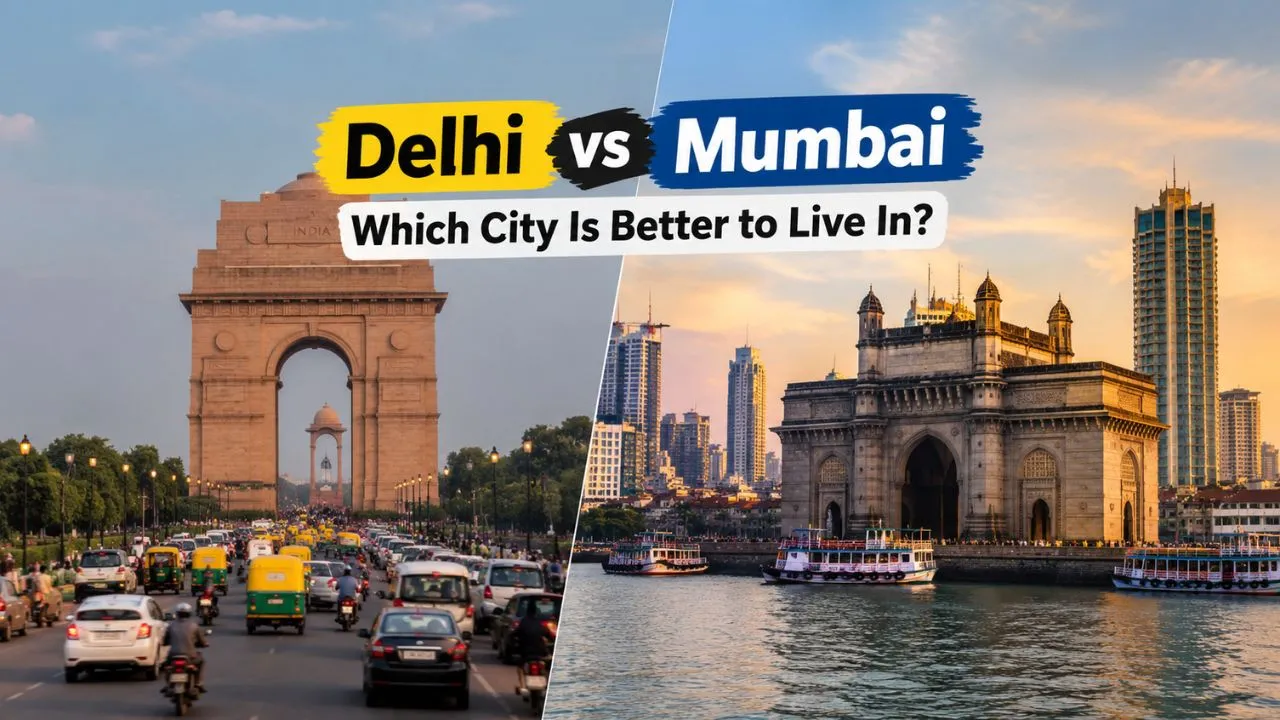
Choosing between Delhi and Mumbai can be difficult, especially if you are planning to move for a job, education, business, or a better lifestyle. Both cities are among India’s most important urban centres, but they offer very different experiences. One is known for its historical monuments, spacious neighbourhoods, political importance, and diverse food culture. The other is famous for its financial industry, entertainment sector, coastal location, and fast-paced lifestyle.
The debate around Delhi vs Mumbai is not simply about which city is bigger or more popular. It is about finding the right place for your needs. Can you afford the rent? Will you find suitable job opportunities? How much time will you spend travelling? Is the local lifestyle right for you and your family?
Delhi may appeal to people who want more housing options across different budgets, while Mumbai can be attractive to professionals seeking opportunities in finance, media, entertainment, and corporate services. However, your experience will depend heavily on your salary, workplace, preferred neighbourhood, and personal priorities.
In this detailed comparison, we will explore the cost of living, house rent, jobs, transport, weather, food, safety, education, and lifestyle in both cities. By the end, you will have a clearer idea of whether Delhi or Mumbai is the better place for you to live.
Delhi vs Mumbai: Quick Comparison
Delhi and Mumbai each have advantages that can make them suitable for different people. The following table provides a general overview of the major differences.
| Factor | Delhi | Mumbai |
|---|---|---|
| Cost of living | Often more affordable | Often more expensive |
| Housing | Wider range of housing options | High rents in many popular areas |
| Job opportunities | Government, IT, services, education, consulting | Finance, media, entertainment, IT, corporate services |
| Public transport | Metro, buses, regional rail | Local trains, Metro, buses |
| Weather | Hot summers and cold winters | Humid weather and heavy monsoon |
| Food | Famous for North Indian food and street food | Famous for street food and regional variety |
| Lifestyle | Varies by neighbourhood; more space in some areas | Fast-paced, with dense neighbourhoods |
| Education | Universities, colleges, and professional institutes | Universities, colleges, and specialist institutes |
| Business | Government-linked, retail, services, and technology | Finance, trade, entertainment, and services |
| Coastal access | No coastline | Arabian Sea coastline |
| Entertainment | Historical sites, markets, malls, and cultural events | Beaches, theatres, nightlife, and entertainment industry |
Key Differences at a Glance
Delhi is a strong option if you value historical attractions, access to government institutions, a variety of housing choices, and North Indian culture. Mumbai is worth considering if you want to work in finance, media, entertainment, or industries concentrated around India’s commercial capital.
However, neither city is automatically better for everyone. Someone earning ₹30,000 a month may have a very different experience from someone earning ₹1 lakh a month. Similarly, living near your office can make either city much more comfortable.
1. Cost of Living in Delhi vs Mumbai
The cost of living is one of the first things to consider when comparing Delhi vs Mumbai. Your monthly budget will generally include rent, groceries, transport, electricity, internet, meals, and entertainment.
In many situations, Delhi offers more affordable housing options than Mumbai, particularly when comparing similar accommodation standards in popular residential areas. Mumbai’s limited space and strong demand for housing can make rent a major expense.
Nevertheless, the difference depends on the neighbourhood and your lifestyle. A person living in an expensive part of South Delhi may spend more than someone living in a less expensive suburb of Mumbai.
Monthly Expenses in Delhi
Delhi offers a wide range of choices for people with different budgets. Students and young professionals can consider shared accommodation, paying guest facilities, or smaller apartments to manage expenses.
Groceries and everyday meals can also be affordable if you shop locally and cook at home. Delhi’s Metro network provides another way to control travel expenses, particularly when your home and workplace are close to stations.
Your monthly expenses may include:
- House rent or shared accommodation.
- Groceries and household supplies.
- Metro, bus, auto, or cab fares.
- Electricity, water, and internet.
- Eating out and entertainment.
- Personal expenses and savings.
People who share accommodation and use public transport can manage their budgets more easily than those who prefer private apartments and frequent cab rides.
Monthly Expenses in Mumbai
Mumbai can be expensive, especially when it comes to housing. A small apartment in a well-connected area may cost considerably more than a similar property in parts of Delhi.
However, Mumbai has accommodation options outside its most expensive neighbourhoods. Shared flats, paying guest facilities, and residential areas farther from major business districts may help reduce monthly costs.
Transport expenses depend on your commute. Local trains can be economical, but travelling during peak hours may be uncomfortable. If your workplace is far from a station, you may also need to pay for an auto or bus.
Eating out, shopping, and entertainment can increase expenses, although affordable local food and markets are available throughout the city.
Which City Is More Affordable?
For many people, Delhi is the more affordable choice, mainly because of its wider range of housing options. However, it is important to compare total monthly expenses rather than rent alone.
For example, a cheaper apartment far from your office may increase your commuting costs and reduce your free time. A more expensive home near work may sometimes offer better overall value.
Verdict: Delhi often has an advantage for people on a limited budget, while Mumbai can still be manageable with careful housing and spending decisions.
2. House Rent and Property Prices
Housing can have a major impact on your quality of life. In the Delhi vs Mumbai comparison, this is one of the clearest areas where your neighbourhood choice matters.
Delhi has a wide variety of residential areas, including independent houses, builder floors, apartments, and shared accommodation. Areas across South Delhi, West Delhi, East Delhi, and neighbouring parts of the National Capital Region offer different price levels and commuting options.
Mumbai has everything from compact apartments to premium high-rise residences. However, the city’s geography and concentration of employment centres contribute to high housing demand. Areas closer to major business districts, railway stations, and popular commercial locations can be particularly expensive.
People moving to Mumbai sometimes choose suburbs to find more suitable accommodation. The trade-off may be a longer daily commute.
Before choosing a home in either city, consider these questions:
- Is the property close to your workplace or college?
- Are public transport facilities easily accessible?
- Does the rent include maintenance charges?
- Is the neighbourhood suitable for your family?
- How much will you spend on commuting each month?
Verdict: Delhi generally offers more flexibility for people looking for space within a limited budget. Mumbai requires particularly careful planning around rent and commute time.
3. Job Opportunities and Career Growth
Both cities provide significant employment opportunities, but the strongest industries differ.
Delhi and the wider National Capital Region have a broad employment base covering government institutions, consulting, education, information technology, retail, healthcare, and corporate services. Gurgaon and Noida are especially important for private-sector jobs, including technology, business services, and multinational companies.
Mumbai is a major centre for banking, financial services, insurance, media, entertainment, advertising, trade, and corporate headquarters. It also offers opportunities in technology, healthcare, retail, and professional services.
Your career goals should guide your decision.
For example, someone interested in film production, television, financial markets, or advertising may find Mumbai particularly attractive. Someone pursuing government examinations, public administration, or opportunities across the Delhi-NCR corporate market may prefer Delhi.
Which City Offers Better Career Growth?
Career growth depends on your profession, experience, qualifications, and the quality of available employers. A higher number of vacancies does not necessarily mean a better job market for every candidate.
If you work in SEO or digital marketing, both cities can be suitable. Delhi-NCR has digital agencies, e-commerce companies, startups, and corporate marketing teams. Mumbai also has marketing agencies, media companies, entertainment brands, and large businesses that need digital marketing services.
Compare the salary offered, company reputation, learning opportunities, office location, and future career prospects before accepting a position.
Verdict: Mumbai may be better for certain finance and entertainment careers, while Delhi-NCR offers a broad mix of corporate, government, education, and technology opportunities.
4. Salary and Earning Potential
A good salary is important, but your take-home income matters more than the headline figure.
Suppose you receive a job offer in Mumbai with a higher salary than a similar position in Delhi. Before deciding, calculate your expected rent, food, travel, and other expenses. If the higher salary is absorbed by housing costs, your actual savings may not improve much.
The same principle applies to Delhi. A job with a slightly lower salary may be financially attractive if you can live close to work and keep your monthly expenses under control.
When comparing job offers, look at:
- Monthly take-home salary.
- Rent and utility expenses.
- Daily commuting costs.
- Health insurance and other benefits.
- Career development opportunities.
- Expected savings after essential expenses.
It is also worth considering long-term growth. A position that helps you develop valuable skills may be more beneficial than a slightly higher-paying job with limited opportunities to advance.
Verdict: Neither city guarantees better savings. Compare the salary against your likely expenses and career prospects.
5. Transportation and Connectivity
Transport influences how much time and energy you have outside work. Delhi and Mumbai both have extensive public transport systems, but the experience of travelling through each city is different.
Delhi’s transport network includes the Delhi Metro, buses, regional rail services, autos, and app-based cabs. The Metro connects many residential, commercial, educational, and shopping areas. It can be especially useful for people whose daily routes align with the network.
Mumbai relies heavily on its suburban railway system, supported by Metro lines, buses, autos, taxis, and app-based cabs. The suburban trains carry large numbers of commuters every day and connect many parts of the metropolitan region.
However, both cities experience congestion. Delhi has significant road traffic in busy areas, while Mumbai’s crowded transport corridors can make peak-hour travel demanding.
Delhi Metro vs Mumbai Local Trains
The Delhi Metro is a major advantage for residents travelling between connected parts of the city and the wider NCR. Its network serves many popular destinations and provides an alternative to road traffic.
Mumbai’s local trains are essential for daily commuting across the metropolitan region. They can be an efficient way to cover longer distances, but peak-hour services are often extremely crowded.
Neither system is perfect. Your experience depends on the station, route, interchange requirements, and distance between your home, station, and workplace.
Verdict: Delhi may suit people whose daily commute is well served by the Metro. Mumbai’s local trains can be highly effective for longer suburban journeys, provided you are comfortable with crowded conditions.
6. Weather and Climate
Weather is another important difference between Delhi and Mumbai.
Delhi experiences a wider range of seasonal temperatures. Summers can be extremely hot, winters can be cold, and air quality may deteriorate during certain periods. Seasonal changes can affect outdoor activities, commuting, and general comfort.
Mumbai has a coastal climate. Temperatures are relatively moderate compared with Delhi’s seasonal extremes, but humidity can be high. The monsoon brings heavy rainfall, which can sometimes disrupt road and rail transport.
Think about the weather you find easiest to manage. If you prefer distinct seasons and can handle hot summers and cool winters, Delhi may suit you. If you prefer a more consistent temperature range and do not mind humidity, Mumbai could be appealing.
However, Mumbai’s rainy season requires preparation, while Delhi’s summers and winters may require different clothing, cooling, or heating arrangements.
Verdict: Mumbai generally has less extreme seasonal temperature variation, while Delhi offers more noticeable changes between summer and winter.
7. Food and Street Food Culture
Food is one of the most enjoyable parts of living in either city. Both Delhi and Mumbai offer an enormous variety of flavours, from inexpensive street snacks to premium restaurants.
Delhi is particularly well known for North Indian food, including chole bhature, parathas, kebabs, chaat, and rich curries. Markets and neighbourhood food streets offer plenty of choices for people who enjoy traditional flavours.
Mumbai has its own famous street-food culture, including vada pav, pav bhaji, bhel puri, and Bombay sandwiches. The city’s food scene also reflects Maharashtra’s regional cuisine and its diverse communities.
Both cities have restaurants serving food from across India and around the world. Vegetarian and non-vegetarian options are widely available, although the selection depends on the neighbourhood.
Food budgets also vary. Local eateries can be economical, while premium restaurants and frequent food deliveries can become expensive.
Verdict: Delhi may appeal more to people who love North Indian food, while Mumbai is a great choice for those who enjoy Maharashtrian flavours and iconic street snacks. Neither city is a clear winner for everyone.
8. Lifestyle and Daily Routine
Life in Delhi and Mumbai can feel very different, even when two people earn similar salaries.
Delhi has neighbourhoods with wider roads, parks, markets, and larger residential properties. The city also has historic monuments, cultural institutions, shopping districts, and places to enjoy outdoor activities. However, the experience varies considerably between central areas, residential colonies, and the wider NCR.
Mumbai is known for its energetic pace, dense neighbourhoods, and strong connection to business and entertainment. The city offers coastal promenades, public spaces, theatres, cafés, and lively markets. Many people appreciate the sense of activity, although limited space and crowded commuting can be challenging.
Daily routine is also shaped by your office location. A person living near work may enjoy either city, while someone travelling for two hours each way may struggle to maintain a healthy work-life balance.
Verdict: Delhi may appeal to people who value space and varied neighbourhoods. Mumbai may suit those who enjoy an energetic urban environment and coastal surroundings.
9. Safety in Delhi vs Mumbai
Safety is an important consideration for anyone moving to a new city. However, comparing Delhi and Mumbai with a single label can be misleading because experiences vary by neighbourhood, time of day, transport choices, and individual circumstances.
Both cities have busy public areas, residential neighbourhoods, commercial districts, and locations where extra caution is sensible. Personal safety can also depend on reliable transport, street lighting, access to assistance, and the condition of the surrounding area.
If you are moving alone, visit prospective neighbourhoods at different times, check the route to your workplace, and ask residents about local conditions. Consider whether you will need to travel late at night and whether dependable transport is available.
Useful precautions include sharing your travel details with someone you trust, using verified transport services, and keeping emergency contacts accessible.
Women, students, and night-shift workers may have specific requirements when selecting accommodation. Look for well-managed housing, secure entry arrangements, and a practical commute.
Verdict: Do not choose solely on the assumption that one entire city is safe and the other is not. Compare the particular neighbourhoods and commuting arrangements relevant to your life.
10. Education and Student Life
Delhi and Mumbai are both important education destinations, attracting students from across India.
Delhi has well-known universities, colleges, professional institutes, coaching centres, and research institutions. Students may also find a broad range of affordable food, shared accommodation, and public transport options, depending on where they study.
Mumbai has universities, business schools, specialist institutes, and colleges offering courses in commerce, finance, media, entertainment, science, and other fields. Students interested in financial services or media-related careers may appreciate its professional environment.
When selecting a city for education, compare the course quality rather than relying on the city’s reputation alone. Tuition fees, admission requirements, placement records, accommodation costs, and internship opportunities all deserve attention.
A student studying in a distant part of either city may also need to budget for a lengthy commute.
Verdict: Delhi can be attractive for a wide range of academic and competitive-exam options, while Mumbai can be especially appealing for finance, commerce, and media-related studies. The right choice depends on your course.
11. Healthcare Facilities
Access to healthcare matters whether you are moving for work, education, or family life.
Delhi has major government hospitals, private hospitals, specialist clinics, diagnostic centres, and medical institutions. Mumbai also has a large healthcare network, including public hospitals, private facilities, and specialist centres.
The best option for you depends on your location, medical requirements, budget, and insurance coverage. A well-regarded hospital on the other side of a congested city may be less convenient than a suitable facility close to home.
Before moving, identify nearby hospitals, pharmacies, and clinics. If you have ongoing medical needs, check whether your preferred specialists are available and whether your insurance policy covers treatment at the relevant facilities.
Families with children or older relatives may want to prioritise neighbourhoods with convenient access to healthcare and emergency services.
Verdict: Both cities offer extensive healthcare options. Location and access to the right specialists are more useful decision factors than choosing one city based on its overall reputation.
12. Pollution and Environmental Quality
Environmental quality can influence comfort, outdoor activity, and long-term lifestyle decisions.
Delhi experiences serious air-pollution episodes, particularly during certain winter periods. Weather conditions, traffic, construction, industrial emissions, and regional sources can all contribute to air-quality problems.
Mumbai also experiences air pollution, including pollution associated with traffic, construction, and other urban activities. Its coastal climate does not mean that every neighbourhood always has clean air.
Conditions can vary by season and location. If air quality is an important concern, check current monitoring data for the neighbourhoods you are considering rather than relying only on citywide averages.
Noise, green space, traffic congestion, and access to parks are also worth considering. A quieter residential area near a park may provide a more comfortable daily environment than a busy road, regardless of the city.
Verdict: Delhi’s severe seasonal air-pollution episodes are a major consideration. Mumbai has environmental challenges too, so check local air quality and neighbourhood conditions before deciding.
13. Entertainment, Shopping, and Nightlife
Both cities offer plenty to do outside working hours.
Delhi has historic monuments, museums, shopping markets, malls, cafés, restaurants, theatres, and cultural events. Areas such as Connaught Place, Chandni Chowk, and Hauz Khas offer different experiences, from heritage and shopping to dining and nightlife.
Mumbai has beaches, waterfront promenades, shopping districts, theatres, restaurants, music events, and a major entertainment industry. Locations such as Marine Drive and Bandra are popular for their distinct urban atmosphere.
Shopping options range from traditional markets to luxury retail in both cities. The main difference is often the type of experience you prefer rather than the availability of entertainment itself.
Consider how much you will actually use these facilities. If you enjoy weekend heritage visits, Delhi has many options. If you prefer coastal walks and a lively entertainment scene, Mumbai may feel more appealing.
Verdict: Delhi stands out for its historical attractions and diverse markets, while Mumbai offers coastal experiences and a particularly strong connection to film and entertainment.
14. Family Life in Delhi vs Mumbai
For families, the decision involves more than rent and salary. Schools, healthcare, commute time, parks, neighbourhood facilities, and access to relatives can all influence quality of life.
Delhi and the wider NCR provide a wide range of residential areas, including apartment complexes, independent houses, and gated communities. Some locations offer more living space for a given budget, although costs differ substantially across neighbourhoods.
Mumbai also has family-friendly residential areas, schools, hospitals, parks, and community facilities. However, housing costs and the distance between home, school, and work may be important considerations.
Parents should compare school fees, transport arrangements, extracurricular activities, and the time needed for daily travel. A shorter commute can leave more time for family meals, homework, and recreation.
If both parents work, nearby childcare and dependable transport may be particularly valuable.
Verdict: Delhi may offer more flexibility for families seeking additional space on a limited budget. Mumbai can work well for families who prioritise its employment opportunities and find a suitable residential area.
15. Business Opportunities
Delhi and Mumbai both provide attractive environments for entrepreneurs, but the best location depends on the business model.
Delhi-NCR has opportunities in retail, education, digital marketing, technology, professional services, wholesale trade, and businesses serving government or corporate customers. Its broader metropolitan area also provides access to different commercial markets.
Mumbai has a strong position in finance, media, entertainment, trade, corporate services, and businesses connected to its commercial ecosystem. It can be particularly valuable for companies that need close relationships with financial institutions, media organisations, or major corporate clients.
Before opening a business, compare customer demand, rent, staffing costs, competition, logistics, and access to suppliers. A city with a large market is not necessarily the most profitable location if operating costs are too high.
For an online business, you may not need to be physically located in the city’s most expensive commercial district. For a shop or service business, the local customer base may matter more than the overall reputation of the city.
Verdict: Choose Delhi for business models that benefit from its NCR market and varied commercial ecosystem. Consider Mumbai for businesses that rely on finance, entertainment, or its corporate and trading networks.
16. Pros and Cons of Living in Delhi
Delhi can be a good choice for people who want a mix of career opportunities, cultural attractions, and different housing options.
Advantages of Delhi
- A broad range of residential options.
- Major Metro connections across many parts of the city and NCR.
- Access to government institutions and educational organisations.
- A diverse food scene and well-known traditional markets.
- Historic monuments, museums, and cultural attractions.
- Employment opportunities across several industries.
Disadvantages of Delhi
- Very hot summers and cold winters.
- Serious seasonal air-pollution episodes.
- Heavy traffic on busy roads.
- Safety concerns that require attention to location and travel arrangements.
- Long commutes for people living far from work.
Delhi may be particularly suitable if you want a large metropolitan environment with multiple housing choices and a broad range of professional opportunities.
17. Pros and Cons of Living in Mumbai
Mumbai offers a distinctive combination of commercial opportunities, coastal surroundings, and cultural energy.
Advantages of Mumbai
- Strong opportunities in finance, media, entertainment, and corporate services.
- Extensive suburban railway and Metro connectivity.
- Access to coastal promenades and beaches.
- A diverse food scene and active cultural life.
- Many professional networking opportunities.
- A lively environment for people who enjoy busy urban areas.
Disadvantages of Mumbai
- High rents in many popular neighbourhoods.
- Limited living space in some housing categories.
- Crowded local trains during peak periods.
- Heavy monsoon rainfall and potential travel disruption.
- High humidity for much of the year.
- Potentially long commutes from more affordable suburbs.
Mumbai may be particularly suitable if your profession benefits from its commercial environment and you are comfortable balancing housing costs against your career opportunities.
Delhi vs Mumbai: Which City Is Better for You?
There is no universal winner in the Delhi vs Mumbai debate. The best city is the one that fits your income, profession, lifestyle, and personal priorities.
Use the following guide to narrow down your choice.
| Your Priority | City Worth Considering |
|---|---|
| More housing choices on a limited budget | Delhi |
| Banking and financial services careers | Mumbai |
| Government jobs and related institutions | Delhi |
| Film, television, and entertainment careers | Mumbai |
| North Indian food and historic attractions | Delhi |
| Coastal surroundings and waterfront walks | Mumbai |
| A course or college with a strong local reputation | Either, depending on the institution |
| Saving money on a modest salary | Compare specific neighbourhoods; Delhi may have an advantage |
| A convenient public-transport commute | Either, depending on your route |
| Family life with more living space | Delhi may offer more options for your budget |
Before making a final decision, create a realistic monthly budget for both cities. Include rent, food, commuting, utilities, medical expenses, and savings. Then compare actual job offers and the neighbourhoods you could realistically afford.
You should also consider your support network. Living near friends or family can make settling into a new city easier, especially during your first few months.
Ultimately, a good job near an affordable home may provide a better life than a higher salary paired with a stressful commute and high living expenses.
Conclusion
The comparison of Delhi vs Mumbai: Which City Is Better to Live In? depends on what you want from your life. Delhi can be a strong choice for people who value housing flexibility, educational options, historical attractions, and employment opportunities across the wider NCR. Mumbai can be an excellent option for people pursuing careers in finance, media, entertainment, and corporate services, particularly if they enjoy coastal surroundings and a fast-moving urban lifestyle.
Both cities have challenges, including traffic, housing pressures, pollution or environmental concerns, and demanding commutes. Neither should be judged only by its reputation.
Before moving, compare your expected salary, housing costs, workplace location, and daily travel time. If possible, visit the neighbourhoods where you might live and speak to people who already work there. The right decision is not about choosing the city everyone says is better. It is about choosing the city where you can build a comfortable, fulfilling, and financially sustainable life.
FAQs
Q1. Is Delhi cheaper than Mumbai?
Delhi is often more affordable than Mumbai, particularly when comparing similar housing options. However, expenses depend on your neighbourhood, rent, commute, food habits, and lifestyle. Compare your total monthly budget before deciding.
Q2. Which city is better for jobs, Delhi or Mumbai?
Both cities offer strong employment opportunities. Delhi-NCR has a broad mix of government, technology, education, consulting, and corporate jobs. Mumbai is particularly important for finance, banking, media, entertainment, and corporate services. The better choice depends on your industry and career goals.
Q3. Is Mumbai safer than Delhi?
Safety varies by neighbourhood, time of day, and individual circumstances. Rather than assuming one entire city is safer, research specific residential areas, transport routes, and local conditions before moving.
Q4. Which city is better for students, Delhi or Mumbai?
Both cities have universities, colleges, and professional institutes. Delhi may appeal to students interested in a wide range of academic programmes and competitive examinations, while Mumbai can be attractive for finance, commerce, and media-related studies. Choose based on the course, institution, fees, and accommodation budget.
Q5. Which city is better for families, Delhi or Mumbai?
Delhi may offer more housing choices for families seeking additional space within a limited budget. Mumbai can also be a good place for families, especially when employment opportunities and school or healthcare access align with their needs. The best option depends on the family’s budget and preferred neighbourhood.